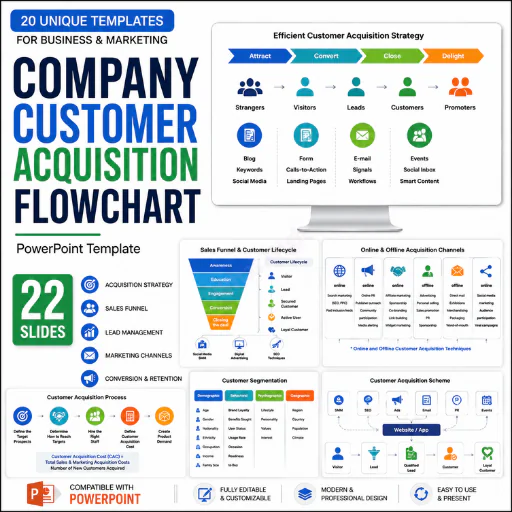
Company Customer Acquisition Flowchart PowerPoint Template – 22 Editable Slides for Customer Acquisition Strategy, Sales Funnel, Lead Management, Marketing Channels, Customer Segmentation & Conversion
Build a clear and professional Customer Acquisition Strategy Presentation with this 22-slide PowerPoint template designed around the complete customer acquisition journey — from attracting prospects and generating traffic to conversion, nurturing, sales, customer retention and loyalty.
This presentation is specifically structured around customer acquisition management, acquisition processes, marketing channels, sales funnels, customer segmentation, customer behavior, lead management, customer acquisition cost, nurturing, automation and conversion. The supplied PowerPoint contains 22 slides, including a title/cover structure and a comprehensive collection of acquisition strategy diagrams, flowcharts, funnels and process visualizations.
Unlike a generic business presentation, this product is focused on how businesses acquire customers. It can help marketing teams, sales departments, growth managers, consultants, agencies, entrepreneurs and business owners explain the complete acquisition system visually.
What Is a Customer Acquisition Flowchart?
Customer acquisition is the process of attracting potential customers, turning them into leads, converting those leads into customers and encouraging continued engagement.
The supplied presentation explains customer acquisition management as the connection between advertising and customer relationship management, with an emphasis on managing customer prospects and inquiries and measuring the effectiveness of promotional activities. It also highlights the importance of a closed-loop reporting system for continuous improvement.
This template converts that complex process into visual presentation structures.
Instead of explaining customer acquisition using long paragraphs, you can show:
Traffic → Awareness → Interest → Lead → Nurturing → Conversion → Customer → Engagement → Loyalty
The presentation also covers the channels and activities that support these stages, including SEO, PPC, social media marketing, email marketing, referrals, PR, events, partnerships, direct mail, advertising, merchandising and offline communication.
What's Inside the 22-Slide Presentation?
The PowerPoint follows a logical customer-acquisition framework and includes multiple visual approaches to explain the same business process from different perspectives.
Slide 1 – Customer Acquisition Strategy
The opening slide establishes the topic of the presentation and introduces the customer acquisition strategy concept.
Use this as the cover slide for a marketing strategy meeting, sales presentation, business workshop, consulting presentation or customer acquisition planning session.
Slide 2 – Key Elements of an Acquisition Strategy
This slide introduces the major components of customer acquisition:
It also introduces supporting activities such as social media marketing, lead management, analytics, lead scoring, personalization, email automation, marketing and sales enablement, and sales force automation.
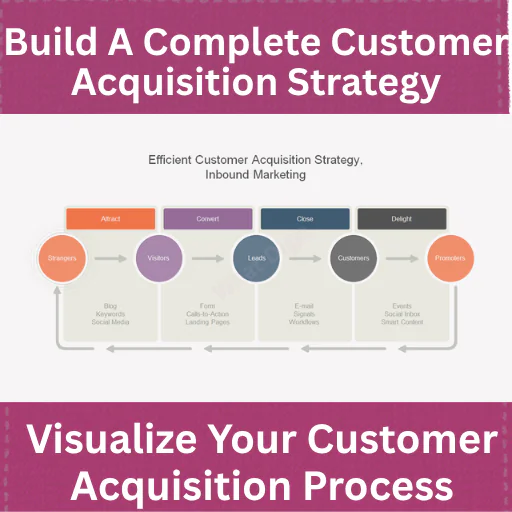
Slide 3 – Efficient Customer Acquisition Strategy
This slide presents an inbound marketing journey:
Attract → Convert → Close → Delight
The customer progression is represented as:
Strangers → Visitors → Leads → Customers → Promoters
The supporting elements include blogs, keywords, social media, forms, calls-to-action, landing pages, email, signals, workflows, events, social inbox and smart content.
This is particularly useful for explaining inbound marketing and the movement from anonymous audience to customer advocate.
Slide 4 – Online & Offline Customer Acquisition Techniques
This slide provides a broad acquisition-channel overview.
The presentation covers online techniques including:
It also includes offline techniques such as:
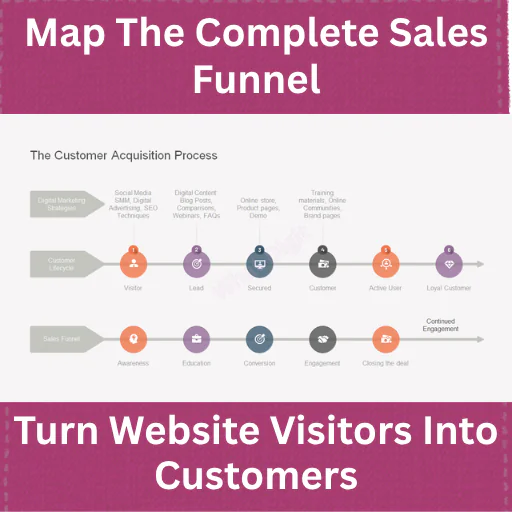
Slide 5 – Sales Funnel & Customer Lifecycle
This slide combines the sales funnel with the customer lifecycle.
It presents stages such as:
Awareness → Education → Engagement → Conversion → Closing the Deal → Continued Engagement
The customer lifecycle moves through:
Visitor → Lead → Secured Customer → Active User → Loyal Customer
Supporting marketing activities include social media, digital advertising, SEO, blog posts, comparisons, webinars, FAQs, product pages, demos, training materials, online communities and brand pages.
Slide 6 – Basics of Customer Acquisition
This slide illustrates the progression of a customer from potential prospect toward a more established customer relationship.
The sequence includes:
Potential Customer → Interested Party → New Customer → Sporadic Customer → Steady Customer
This can be adapted for customer lifecycle discussions, lead progression or relationship-development presentations.
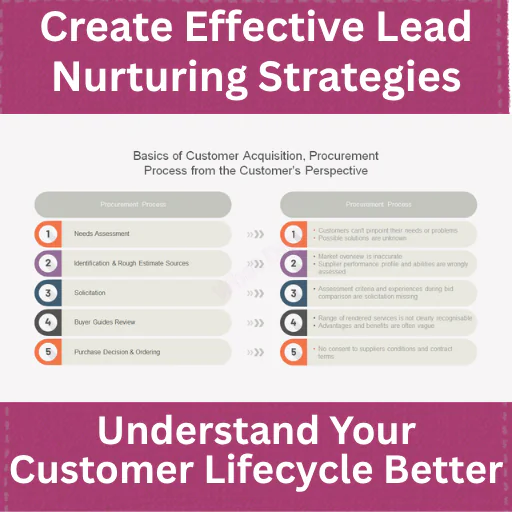
Slide 7 – Procurement Process From Customer Perspective
This slide looks at acquisition from the customer's perspective rather than the company's perspective.
The procurement process includes:
The slide also highlights common customer-side difficulties, including unclear needs, unknown solutions, inaccurate market understanding, uncertainty around supplier capabilities, unclear assessment criteria and uncertainty around service benefits and contract terms.
Slide 8 – Factors of Customer Acquisition
This slide identifies the factors influencing customer acquisition:
These elements provide a useful framework for understanding why a prospect chooses one provider over another.
Slide 9 – What Influences Customer Choice?
This slide expands the acquisition factors into customer-oriented questions.
It explores:
Slide 10 – Types of Customers
The presentation identifies several customer types:
Each type is accompanied by behavioral characteristics and communication considerations.
This makes the slide useful for sales training, customer service training and prospect-handling workshops.
Slide 11 – Customer Segmentation
This slide provides a four-part customer segmentation framework.
Demographic
Behavioral
Psychographic
Geographic
Slide 12 – Understand Your Customers
This slide focuses on customer understanding through questions such as:
What do they do?
When do they buy?
How do they buy?
What do they expect from you?
It also addresses understanding the customer's purchase cycle, occupation, interests, company size and preferred interaction methods such as website, app and in-person communication.
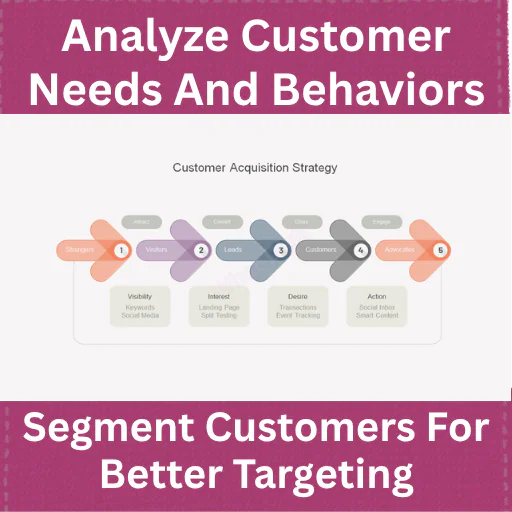
Slide 13 – Customer Acquisition Strategy Funnel
This slide presents another acquisition framework:
Attract → Convert → Close → Engage
The customer journey moves through:
Strangers → Visitors → Leads → Customers → Advocates
Supporting concepts include keywords, social media, visibility, landing pages, split testing, interest, transactions, event tracking, desire, social inbox and smart content.
Slide 14 – Customer Acquisition Strategy
This slide introduces acquisition and conversion metrics and concepts including:
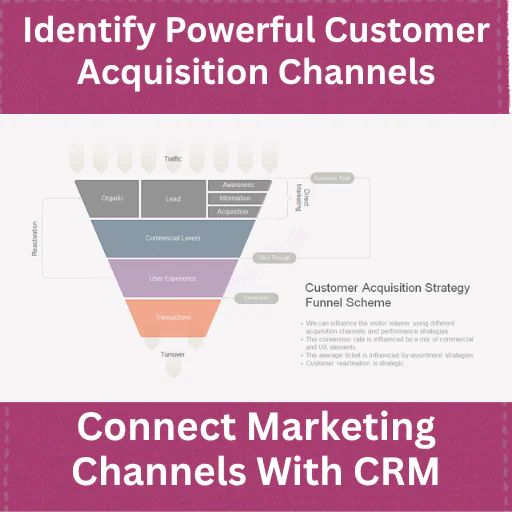
Slide 15 – Customer Acquisition Funnel Scheme
This slide connects Traffic, Awareness, Information, Acquisition, Transactions, User Experience, Conversion, Reactivation and Turnover.
It also explains that visitor volume can be influenced through different acquisition channels and performance strategies, while conversion depends on commercial and user-experience elements.
Slide 16 – Customer Acquisition Process Step-by-Step
This is one of the most practical slides in the presentation.
It covers:
The slide explains that customer acquisition cost can be calculated by dividing total sales and marketing acquisition costs by the number of new customers acquired during a given period.
Slide 17 – Customer Strategy Plan
This slide organizes acquisition around:
Driving Traffic → Conversion → Nurturing → Sales
Supporting activities include:
Slide 18 – Popular Customer Acquisition Channels
This slide presents a broad acquisition-channel strategy including:
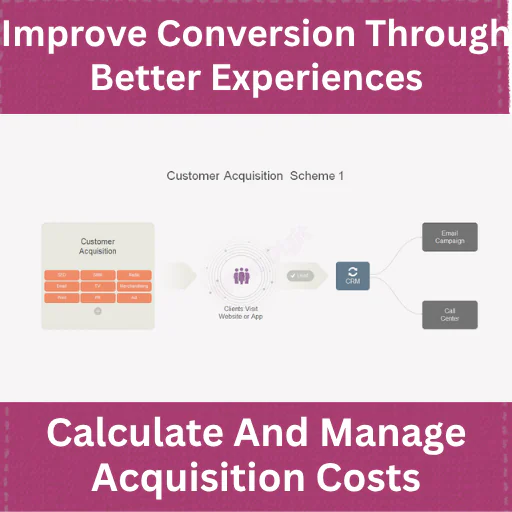
Slide 19 – Customer Acquisition Scheme 1
This visual scheme connects acquisition channels such as:
SMM → SEO → Radio → TV → Merchandising → Email → PR → Advertising → CRM
It then connects customers visiting the website or app, email campaigns, call-center activity and lead progression.
This makes the slide suitable for explaining how multiple acquisition channels feed into a centralized customer relationship process.
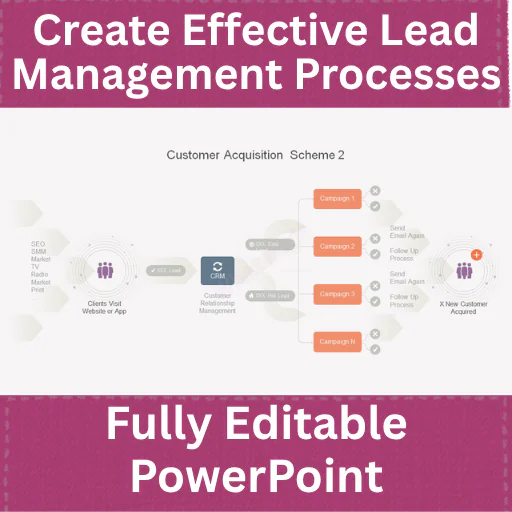
Slide 20 – Customer Acquisition Scheme 2
This slide presents a more detailed lead-management framework involving:
It can be adapted to explain how leads move through campaigns and follow-up processes.
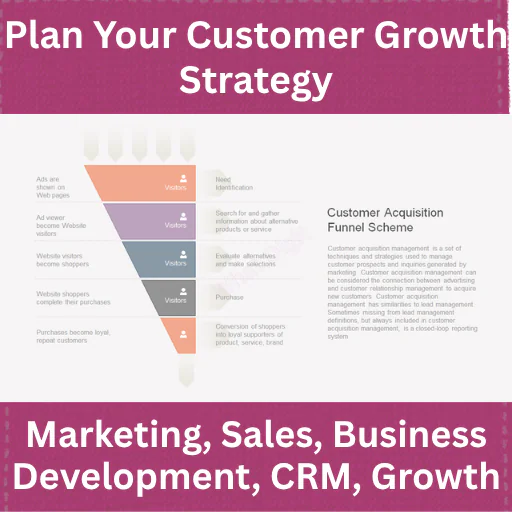
Slide 21 – Customer Acquisition Funnel Scheme
The final content slide explains the progression from advertising exposure to customer loyalty:
Ads → Website Visitors → Shoppers → Purchasers → Loyal Repeat Customers
It also introduces customer decision stages including:
Need Identification → Information Search → Evaluation of Alternatives → Purchase → Conversion Into Loyal Supporters
Slide 22 – Closing / Presentation Structure
The 22-slide PowerPoint structure provides the final presentation space for closing information or presentation completion.
Color & Design Theme
The supplied PowerPoint should be positioned as a professional business strategy / marketing flowchart presentation, with its visual emphasis placed on diagrams, process structures, funnels, circular relationships, customer journeys and acquisition frameworks rather than decorative presentation imagery.
The strongest design characteristic of this deck is its information-visualization approach. Instead of relying heavily on photographs, it uses flowcharts, process diagrams, connected stages, funnels, segmented frameworks, arrows, labels and structured content blocks.
This makes the product particularly appropriate for:
The theme should therefore be marketed for its strategic visual communication, not as a conventional corporate profile deck.
Key Features
Best For
This PowerPoint template is especially suitable for:
Who Should Use This?Marketing Professionals
Use the acquisition-channel and funnel slides to explain how traffic, leads, conversions and customer engagement work together.
Sales Teams
Use the customer-type, lead-management and conversion slides for sales training and prospect management.
Business Consultants
Use the strategic frameworks to explain customer acquisition problems and recommend structured solutions.
Startup Founders
Use the presentation to establish a customer acquisition system for a new business.
Marketing Agencies
Build client presentations explaining acquisition channels, funnels, lead nurturing and conversion strategies.
CRM & Growth Teams
Use the CRM, lead scoring, automation and lifecycle concepts to communicate acquisition workflows.
Real-World Case Study
Consider a SaaS company that is generating website traffic but struggling to convert visitors into paying customers.
The company could use this presentation to map its acquisition system.
First, it could identify the acquisition channels generating traffic — such as SEO, social media, PPC and email.
Next, the company could map the funnel:
Visitor → Lead → Qualified Lead → Customer → Loyal Customer
The customer segmentation slide could then identify target groups based on demographic, behavioral, psychographic and geographic characteristics.
The company could use the customer-needs slide to understand when prospects buy, how they research products and what they expect.
The acquisition-cost framework could help management understand the cost associated with acquiring new customers.
Finally, the lead-management and automation slides could be used to explain how leads are scored, nurtured and followed up.
The presentation therefore becomes a practical framework for explaining a complete customer acquisition system rather than simply being a collection of attractive slides.
Files Included
1 × PowerPoint Presentation
22 Slides
The presentation covers:
The supplied file contains 22 slides, although its opening slide refers to a collection of “20 Unique templates for Business & Marketing.” The actual PowerPoint file contains 22 slides, which is the figure used for this product listing.
Important Notes
Frequently Asked Questions1. What is this PowerPoint template?
It is a 22-slide Customer Acquisition Strategy and Flowchart PowerPoint Template covering customer acquisition, lead management, marketing channels, sales funnels, segmentation, conversion and customer lifecycle.
2. How many slides are included?
The actual PowerPoint file contains 22 slides.
3. Is this a customer acquisition template?
Yes. Customer acquisition is the central subject of the presentation.
4. Does it include sales funnels?
Yes. Multiple slides use sales-funnel and customer-lifecycle structures.
5. Does it include customer segmentation?
Yes. The template includes demographic, behavioral, psychographic and geographic segmentation.
6. Does it include marketing channels?
Yes. Both online and offline customer acquisition channels are presented.
7. Does it include SEO and social media?
Yes. SEO, social media marketing and other digital acquisition methods are included.
8. Does it include lead nurturing?
Yes. Lead nurturing, lead scoring, email automation and marketing automation are included in the acquisition strategy framework.
9. Can sales teams use it?
Yes. The sales funnel, customer types, conversion, lead management and follow-up concepts are useful for sales presentations and training.
10. Can marketing agencies use it?
Yes. Agencies can use it for client strategy presentations and acquisition planning.
11. Can startups use it?
Yes. Startups can use the process and funnel slides to explain their customer acquisition strategy.
12. Does it cover customer behavior?
Yes. The presentation includes customer types and customer-needs analysis.
13. Does it explain customer acquisition cost?
Yes. The step-by-step acquisition process includes a framework for defining Customer Acquisition Cost.
14. Does it include CRM concepts?
Yes. CRM appears in the customer acquisition schemes alongside campaigns, leads, follow-ups and customer management.
15. Can I present online and offline marketing together?
Yes. The presentation explicitly separates and organizes online and offline acquisition techniques.
16. Can I use the slides for training?
Yes. The customer types, acquisition process, customer segmentation and funnel slides are suitable for sales and marketing training.
17. Is this suitable for consultants?
Yes. Consultants can use the diagrams to explain customer acquisition strategy and identify potential process improvements.
18. Does it include customer retention?
Yes. The customer lifecycle and final funnel include continued engagement and loyal customers.
19. Is this a finished strategy?
No. It is a presentation template/framework. Your company's acquisition channels, customer segments, metrics and processes should be customized.
20. What makes this template different from a normal business presentation?
Its primary focus is customer acquisition architecture. Instead of generic company-profile slides, it provides funnels, acquisition channels, lead-management structures, customer segmentation, customer behavior and acquisition-process diagrams.

This item was featured on What Digit
Published:
Aug 30, 2026 09:51 PM
Category: